
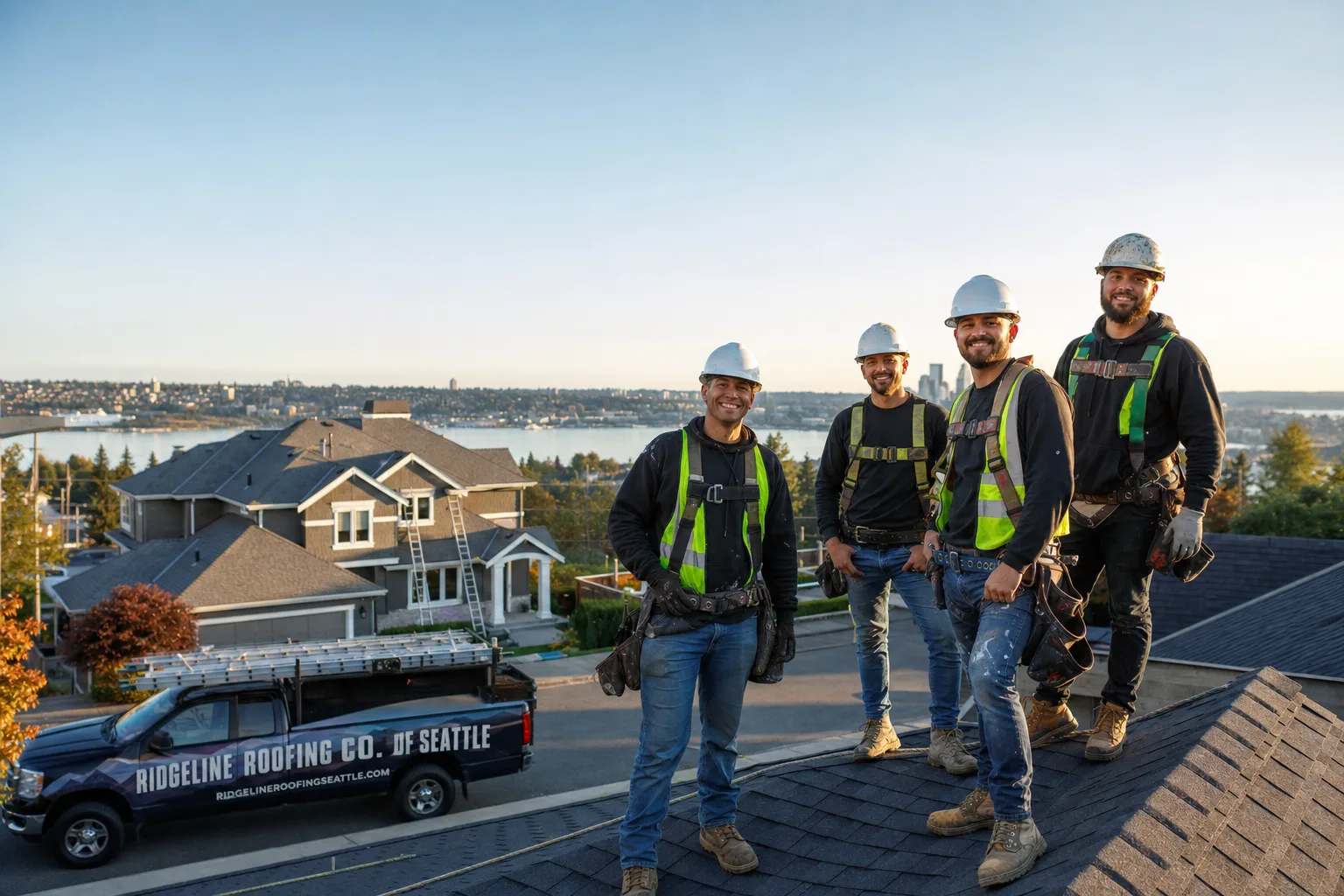
Fast, Reliable Specialty Roofing Across Bangor Trident Base
Specialty roofing on Bangor Trident Base requires DBIDS-certified contractors who understand military housing protocols, not just any roofer with a ladder. We carry active Defense Biometric Identification System credentials and coordinate directly with Hunt Military Communities, the privatized housing management company that oversees all base housing roof work. Our crews are background-checked, uniformed, and arrive with the proper access paperwork already filed, so we’re not turned away at the gate or stuck explaining protocols to a resident who cannot authorize repairs. Call (866) 850-9676 and a live person will answer, day or night, to schedule your inspection or emergency repair.
We’ve worked on base housing along Whidbey Avenue, in the neighborhoods near the Naval Base Kitsap perimeter, and throughout the 98315 ZIP code since long before Hunt took over management. The Douglas fir canopy here traps moisture against roofs in ways open suburban tracts don’t. We know which government-built sheathing specs were used in the 1960s construction waves versus the 1990s builds, and we stock the right materials so we’re not guessing.
Why Ridgeline Roofing Co. of Seattle Is Bangor Trident Base’s Preferred Specialty Roofing Company
Neil Cavanaugh founded Ridgeline Roofing Co. in 1984, and we’ve spent over four decades building a reputation on doing what we say we’ll do. That matters on Bangor Trident Base, where a contractor who misses a DBIDS renewal or fumbles Hunt’s work-order system wastes a resident’s time and their own. We don’t.
Our 90-Day Done Right Promise applies to every base housing job we complete: if something isn’t right, we come back and make it right, no paperwork, no arguing. Technicians document every inspection with photos taken from your actual roof, not the driveway, and we provide upfront pricing so the estimate matches the invoice. We’ve earned strong reviews from Bangor Trident Base residents who appreciate that we understand their housing situation, that we know Hunt’s protocol, and that we show up when we say we will. Most specialty roofing repairs on base are completed in a single visit once access and authorization are confirmed.
Our phones are staffed by a live person 24 hours a day, seven days a week, including during storms when base housing roofs take the worst of the Kitsap Peninsula wind and rain. We don’t use voicemail trees or callback windows. When a roof is leaking onto a service member’s family, that matters.
Our Specialty Roofing Services in Bangor Trident Base
Modified Bitumen Roofing
Modified bitumen is our most-requested specialty roofing solution on Bangor Trident Base, and for good reason. The low-slope porch roofs and carport covers on the 1970s and 1980s housing units were originally built with built-up roofing that has now exceeded its lifespan. We recently installed a modified bitumen roof on a 1980s-era two-story unit on Whidbey Avenue, where the low-slope porch roof had developed persistent ponding due to the original built-up roof’s age. After coordinating with Hunt’s work-order system, we stripped the old layers, applied a tapered insulation system, and torched down the modified bitumen, ensuring proper drainage and documentation through the required protocol. The torched application creates a monolithic seal that handles the 55-60 inches of annual rainfall the Kitsap Peninsula delivers without the seam vulnerabilities of older systems.
TPO Roofing
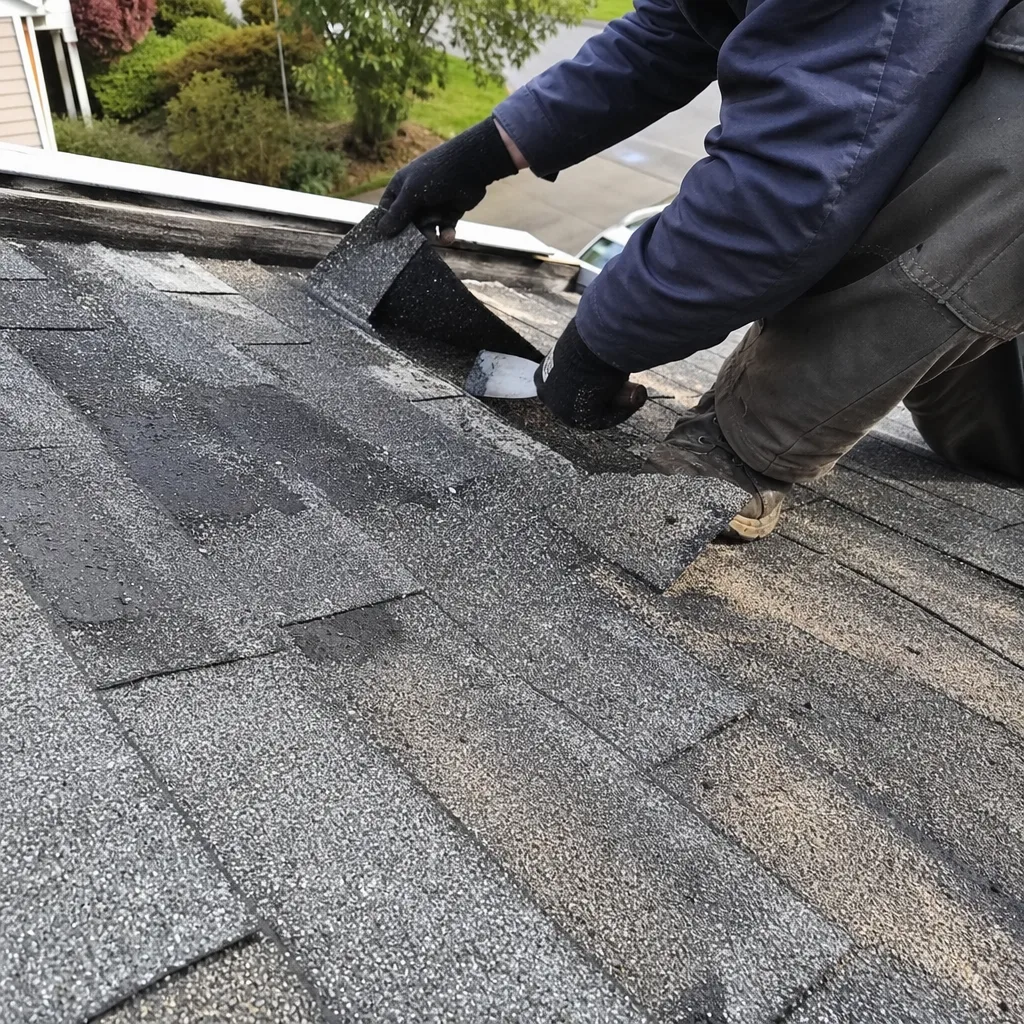
TPO, or thermoplastic polyolefin, brings reflective white surfacing that reduces cooling load during Bangor Trident Base’s brief but intense summer stretches. The single-ply membrane installs efficiently on low-slope additions and renovated housing units where Hunt Military Communities has approved energy-upgrade pathways. We heat-weld seams in the field, creating joints stronger than the membrane itself, and we source TPO in thicknesses that match the structural load limits of the standardized government-built decks. For base housing managers tracking utility costs, TPO’s reflective surface can measurably reduce air conditioning demand in south-facing units near the base perimeter.
Built-Up Roofing
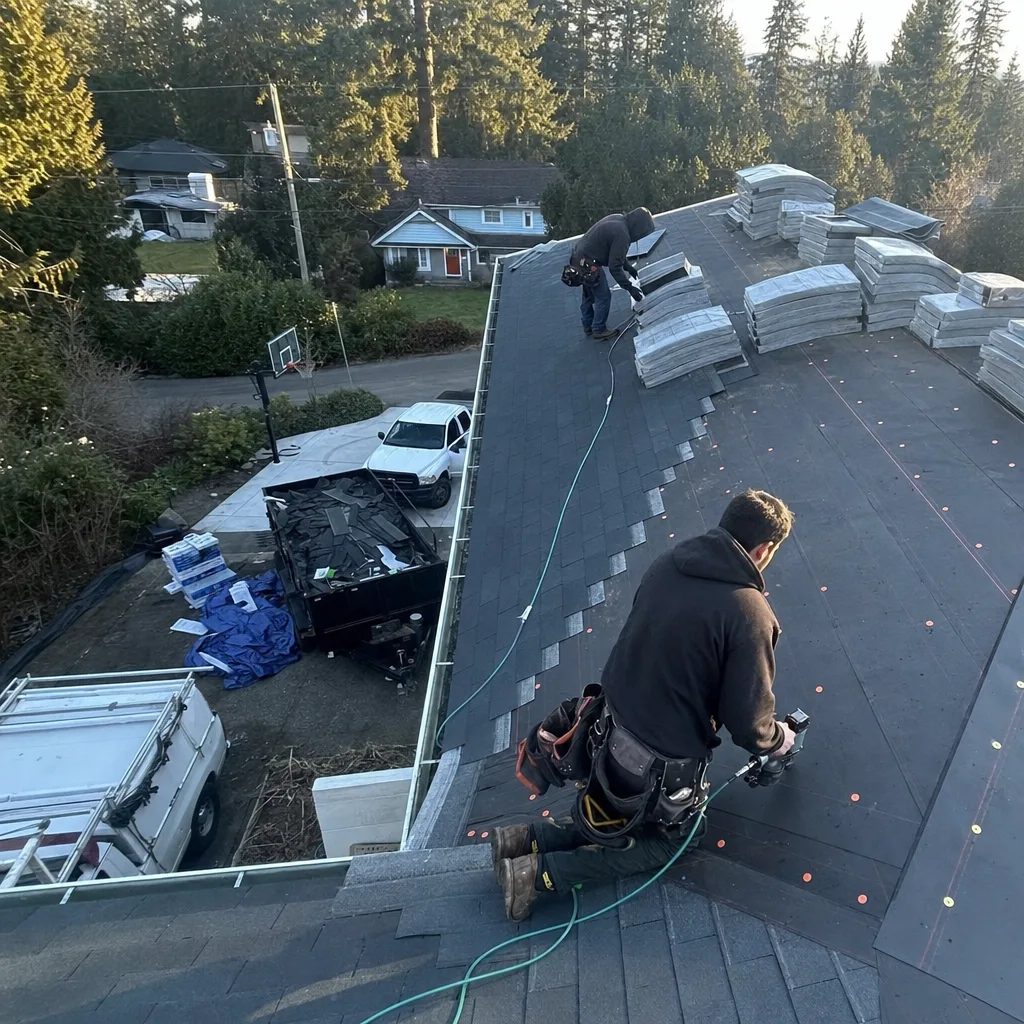
Some Bangor Trident Base structures still carry original built-up roofing, and where replacement isn’t yet in Hunt’s capital plan, we perform targeted repairs and surfacing to extend service life. Built-up roofing’s multiple ply layers handle foot traffic well, which matters on base housing with rooftop HVAC and satellite equipment access. We apply flood coats of asphalt and embed new cap sheet where deterioration is localized, always matching the existing slope and drainage pattern. On government-built structures with uniform framing, we’ve learned that the original built-up systems were installed to a tighter specification than many civilian equivalents of the same era, so partial restoration is often more viable than complete tear-off.
EPDM Roofing
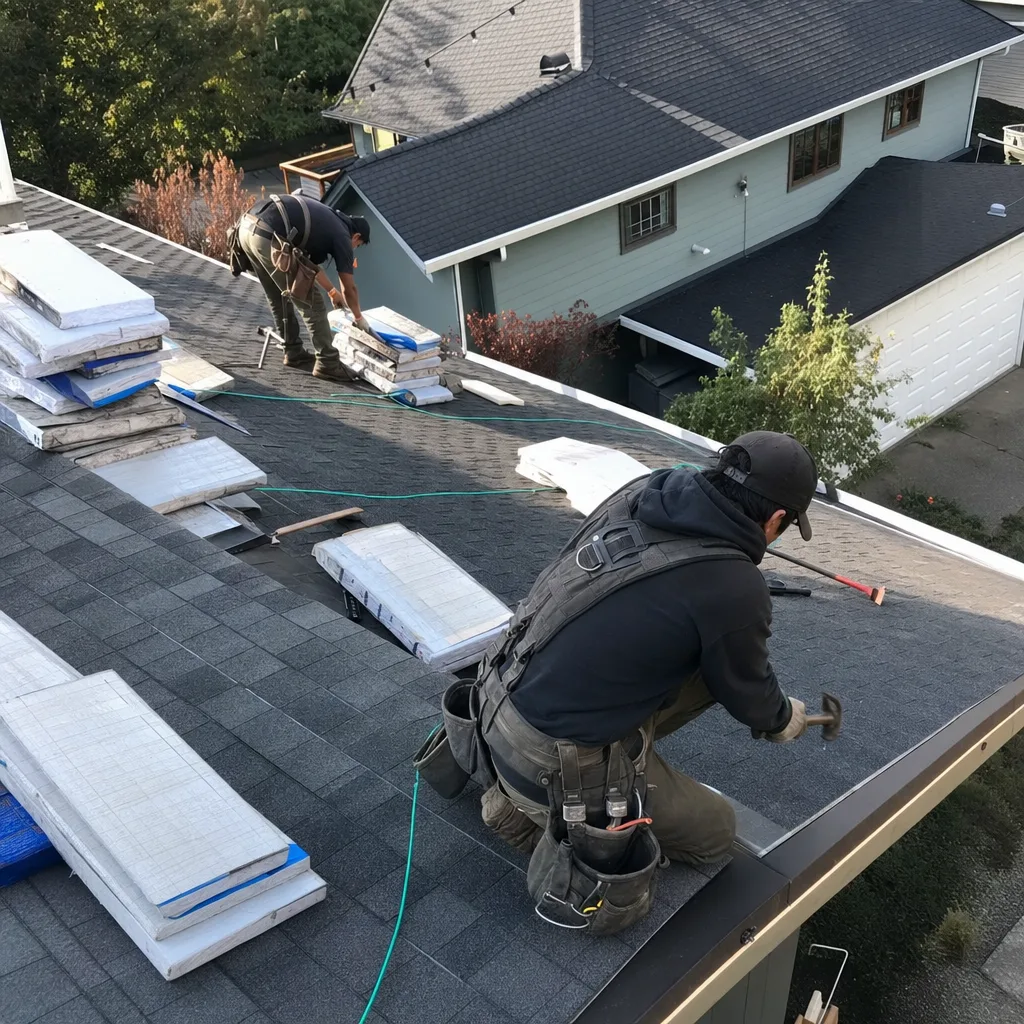
EPDM rubber membrane remains a cost-effective specialty option for detached auxiliary buildings and some carport structures on Bangor Trident Base. The black membrane absorbs winter heat, which helps shed the moss and ice accumulation that plague shingled surfaces under the dense fir canopy. We install EPDM with fully adhered or mechanically fastened systems depending on the substrate condition, and we detail penetrations with cured flashings that outlast tape-applied alternatives. For base housing residents whose work-order requests specify EPDM replacement, we coordinate materials and scheduling through Hunt’s system without adding bureaucratic steps for the occupant.
Solar Ready Roofing
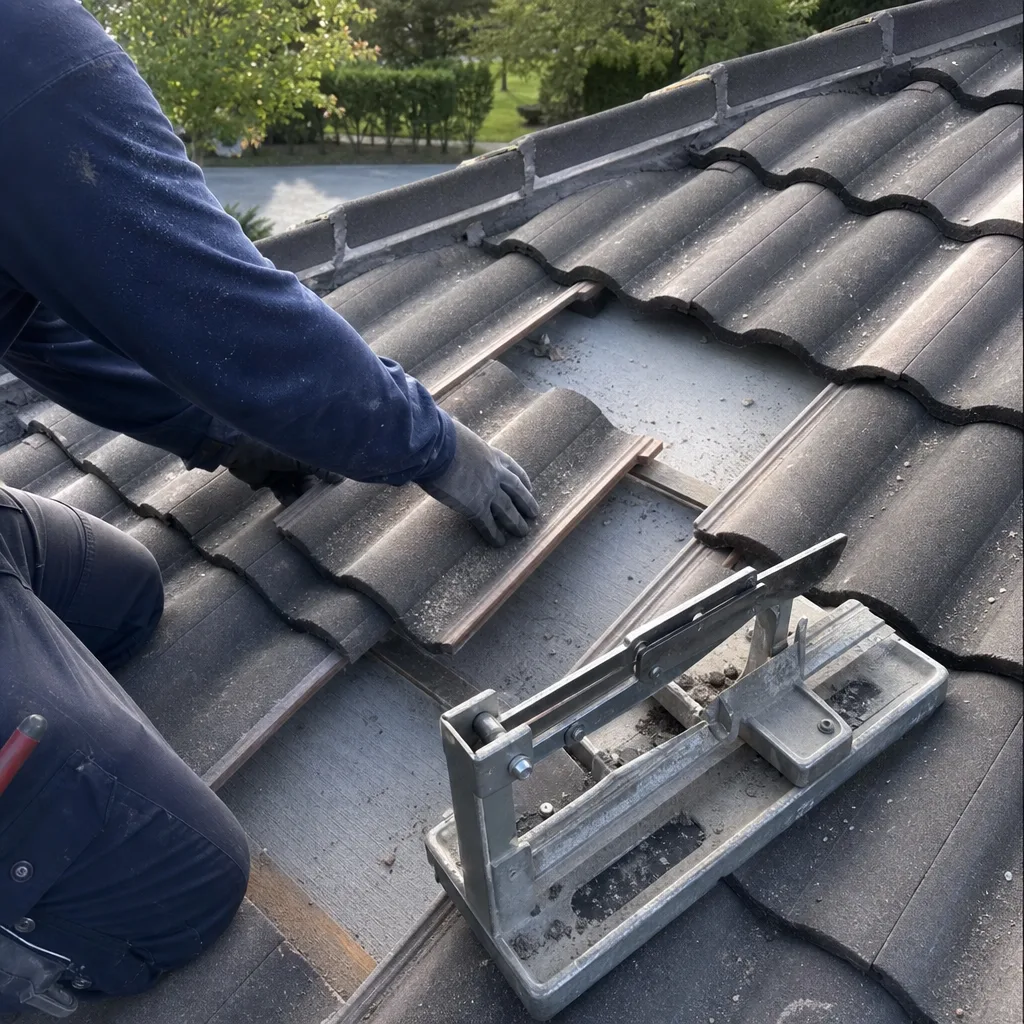
Bangor Trident Base’s position on the Kitsap Peninsula receives sufficient annual solar irradiance to make photovoltaic installation viable, and Hunt Military Communities has approved solar-ready roofing on select renovated units. Our solar-ready installations use decking and underlayment systems engineered to accept rack mounting without compromising the waterproofing layer. We coordinate with Hunt’s engineering review for structural load verification, then install the roofing substrate so that a future solar contractor can attach without penetrating our work. The 90-Day Done Right Promise covers the roofing component; we document every penetration point with photos for the resident’s file.
Green Roof
Green roof systems, with their living plant layers and drainage mats, are not currently approved for standard base housing under Hunt Military Communities’ maintenance protocols. The structural load of saturated growing media exceeds the design capacity of most government-built 1960s-1990s framing, and the intensive maintenance requirements conflict with standardized housing management. We have evaluated green roof feasibility for standalone administrative structures on base where engineering review permits, but for typical family housing units, we recommend cool-roof alternatives like TPO or reflective modified bitumen that deliver thermal benefits without the structural and maintenance burdens.
What happens when you call
- 1
A real person answersNo phone trees - you reach a local pro.
- 2
You get an upfront price rangeHonest numbers before anyone is dispatched.
- 3
A background-checked tech heads outLicensed & insured, dispatched right away.
- 4
You approve before work beginsNothing starts until you say go.
Trusted Brands We Service in Bangor Trident Base
We are authorized installers for IKO, Atlas, and Tamko, and we stock membrane rolls, flashing components, and specialty adhesives matched to these manufacturer specifications. For Bangor Trident Base jobs, this means no waiting on cross-sound freight from Seattle when a Hunt work-order approval comes through on short notice. We carry TPO and modified bitumen inventory in our Kitsap-area warehouse, and our technicians train directly with manufacturer reps on proper torch-application and heat-welding techniques. Using specified materials, not substitutions, keeps warranty coverage intact and keeps us from returning to fix what should have been done once.
Common Specialty Roofing Problems We See in Bangor Trident Base Homes
- DBIDS access failures by uncredentialed contractors. Roofers who arrive at the gate without current Defense Biometric Identification System credentials are denied entry, forcing residents to reschedule and sometimes forfeit their place in Hunt’s maintenance queue. We renew our credentials quarterly and verify base access before confirming any appointment.
- Moss and lichen acceleration under dense canopy. The Douglas fir and western red cedar overhang on base housing streets traps moisture and blocks ultraviolet exposure that would otherwise slow biological growth. Biennial soft-wash treatment and zinc-strip installation near the ridge are near-mandatory, not optional, for roof longevity here.
- Ponding on low-slope original built-up roofs. Decades of compression and inadequate original slope design create water pooling that breaches the membrane and rots the standardized plywood decking. We address this with tapered insulation systems during modified bitumen or TPO replacement, not just new membrane over the same flawed geometry.
- Storm damage documentation routed to the wrong party. Contractors unfamiliar with military housing protocols hand paperwork to residents, who cannot authorize repairs under Hunt’s management contract. We submit all damage documentation directly through Hunt’s work-order system, maintaining the chain of custody that keeps claims moving.
Pricing for Specialty Roofing in Bangor Trident Base, WA
Specialty roofing on Bangor Trident Base runs higher than comparable civilian work, and the reason is straightforward: DBIDS credentialing, background-check requirements, and Hunt Military Communities’ administrative coordination add time and compliance cost that storm-chasing outfits won’t absorb. A typical modified bitumen repair on a base housing low-slope section runs $1,800-$3,400. Full TPO membrane replacement on a standard unit’s porch roof ranges $4,200-$7,800. Built-up roof restoration with new flood coat and cap sheet runs $2,400-$4,600 for localized work; complete tear-off and replacement pushes $8,500-$14,000 depending on deck condition and access constraints.
EPDM installations on auxiliary structures start around $3,200 for single-ply replacement. Solar-ready roofing substrate installation, where Hunt has approved the upgrade pathway, runs $5,500-$9,800 including engineering coordination. These ranges assume standard base housing dimensions; multi-unit connected structures or buildings with limited ladder-access may run higher. Every estimate we provide is the price you pay. We don’t tack on “access fees” or “base surcharges” after the fact. Call (866) 850-9676 for a free, written estimate with no obligation.
| Service | Typical Range in Bangor Trident Base |
|---|---|
| Modified bitumen repair | $1,800 - $3,400 |
| TPO membrane replacement | $4,200 - $7,800 |
| Built-up roof restoration (partial) | $2,400 - $4,600 |
| Built-up roof full replacement | $8,500 - $14,000 |
| EPDM single-ply replacement | $3,200 - $5,800 |
| Solar-ready substrate installation | $5,500 - $9,800 |
We Also Serve Cities Near Bangor Trident Base
Our DBIDS-certified crews and standard civilian teams cover the full Kitsap Peninsula area. We provide Specialty Roofing in Bangor Trident Base alongside our work in Silverdale, Poulsbo, Tracyton, and Bremerton. Each market has its own housing stock and its own weather patterns, and we adjust our materials and methods accordingly. For base housing, our Specialty Roofing team handles the additional credentialing and coordination that off-base jobs don’t require.
Serving Bangor Trident Base, WA - Our Local Coverage Area
We’re based in the Bangor Trident Base area and know this community well. Use the map below to see our service coverage - if you’re nearby, we can almost certainly help.
FAQs - Specialty Roofing in Bangor Trident Base
Contractors must obtain a Defense Biometric Identification System credential through the Naval Base Kitsap visitor control center, pass a background check, and maintain current sponsorship from a base-affiliated entity such as Hunt Military Communities. The process typically takes two to three weeks for initial issuance, with annual renewal required. Ridgeline Roofing Co. maintains active DBIDS credentials and renews quarterly to avoid any lapse that would block access. Call (866) 850-9676 to verify our current status before scheduling.
Storm damage on base housing must be reported through Hunt Military Communities’ work-order system, not to the resident or to a contractor directly. The resident initiates the work order, Hunt dispatches or approves a contractor, and all documentation flows through that system. Contractors who hand damage reports to residents create delays because residents cannot authorize repairs under the management contract. We know the protocol and submit our inspection photos and damage assessments directly to Hunt’s designated channel.
Yes, TPO and modified bitumen are approved for base housing low-slope and porch roof applications where Hunt Military Communities has authorized replacement. We stock both membrane types in our Kitsap warehouse and carry manufacturer authorizations for proper installation. Availability for a specific unit depends on Hunt’s capital improvement schedule and work-order approval, not on material scarcity. Once approved, we typically complete installation within five to seven business days.
No, green roof systems are not approved for standard Bangor Trident Base family housing. The structural load of saturated growing media exceeds the capacity of most government-built framing from the 1960s through 1990s, and the intensive maintenance requirements conflict with Hunt Military Communities’ standardized management approach. For residents seeking thermal and environmental benefits, we recommend cool-roof alternatives like white TPO or reflective modified bitumen, which deliver measurable cooling-load reduction without structural modification.
The dense Douglas fir and western red cedar canopy overhanging base housing neighborhoods traps moisture and blocks sunlight, creating conditions that accelerate moss, lichen, and algae colonization far beyond what open suburban areas experience. Zinc strips installed near the ridge release metal ions during rainfall that inhibit biological growth across the roof surface. On Bangor Trident Base, where the 55-60 inches of annual rainfall and persistent canopy shade create near-ideal moss habitat, biennial soft-wash treatment combined with zinc-strip installation is the standard maintenance protocol for extending membrane and shingle life. We include zinc-strip assessment in every base housing inspection and install them during replacement jobs where the structure allows.
Ready to get your base housing roof problem handled the right way? Call (866) 850-9676 now. A live person will answer, we’ll confirm our current DBIDS status, and we’ll schedule your free estimate with upfront pricing that matches your final invoice. We’ve been standing behind local roofs since 2016, and we’re not going anywhere.
Written by Neil Cavanaugh, Owner at Ridgeline Roofing Co., serving Bangor Trident Base since 2016.